I think game theory is awesome. First of all, it is the most ingeniously named field in the history of thought. Who doesn’t want to study something called “game theory”? Marketing!
Second of all, it forces a student—it certainly forced me—to confront kinds of logic, problem-solving, and epistemological questions that are quite different to the norm. Certainly quite different to the norm elsewhere in economics, at least. It is thinking about thinking, which for a certain type of person is a fun rabbit hole.
Game theory is about how we can try to understand situations in which the outcome of my choice depends also on what you choose. These are situations with strategic interaction. I can’t just pick the thing I like best, as in the standard rational choice model. I have to think about what you want, what you might do, how you might respond, what you think about me, what you think I might do—and you have to think all of those things right back at me. It’s gnarly!
So I saw this at the Browser today:
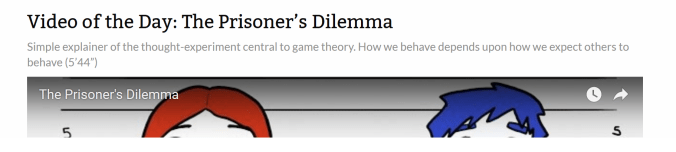
How often do you see a reference to game theory that isn’t about the prisoner’s dilemma? Very seldom, if ever, I think, and in my opinion game theory is worse for it.
I include in that references to game theory in academic courses too, by the way. I’ve taught game theory for undergraduates many times (in the context of applications to economics), and it’s remarkable how many students come to those classes under the impression that game theory is the prisoner’s dilemma. I don’t think they are wholly to blame for the mistake.
I’m not here to tattle on anyone, but I’ve had smart students show up at game theory class and tell me that game theory is about how you should rat out your friends. Uh oh!
Now, I come not to praise the prisoner’s dilemma, but nor do I want to bury it. First, it swiftly and usefully undermines the notion that decentralized decision-making necessarily leads to mutually beneficial outcomes. Second, as with any simple game, it can be extended and varied in endless ways to tell many rich and useful stories—most obviously by thinking about a repeated prisoner’s dilemma with inducements, rewards, and punishments. Third, it’s a useful parable for a variety of real-world situations.
There are more qualities of the game, of course. For a dive into the depths of what it can teach us, I recommend its entry in the Stanford Encyclopedia of Philosophy.
But here’s the problem: the vanilla prisoner’s dilemma is the least interesting game in game theory. I’m not going to rehash the setup again here (trust me, it’s been done enough). The reason it’s the least interesting game is that the very point of the prisoner’s dilemma is that its setup gives each of the two players in the game a unilateral incentive to make a given choice.
The vanilla prisoner’s dilemma boils down to the smallest variation on the rational choice model. I don’t particularly need to think about what you might do, or what you might be thinking. No matter what you do, one of my options is always better. Yeah, it carries a non-trivial lesson, but to me it just seems so flat. I don’t really get much of a hint of the mind-bending joys of game theory from it. If this is game theory, then game theory isn’t much at all.
And so often, in my experience, students see the vanilla prisoner’s dilemma, see it called game theory, and then move on to something else. Nothing else is being imprinted on them about the example or the field. I think that’s a shame.
So in that spirit I call on those of us who would like to touch on game theory in non-game theory course, or those of us who write game theory into introductory economics texts, to consider showing, instead of or as well as the prisoner’s dilemma, some different interesting games. Here are a few of my suggestions:
- The Keynesian beauty contest is another very famous game. I think it is super useful in a classroom setting. It gets very quickly at many of the “big questions” in the study of games and it’s a lot of fun to play and argue about in a group. It also unleashes “One, Two, (Three), Infinity, … : Newspaper and Lab Beauty-Contest Experiments” by Rosemarie Nagel et al, which is one of my all-time favorite papers to teach, especially its peerless appendix.
- The centipede game is not a million miles away in spirit from the prisoner’s dilemma, but it is (i) way more fun for students to play in the classroom, and (ii) teaches the power and weirdness of backward induction. Also an introduction to the thorniest problem for the typical game theory student, that “a strategy” is a pre-play complete contingent plan, not an on-the-fly decision. Bonus: the “crazy centipede” variant: what if there’s a tiny chance that my opponent is irrationally cooperative?
- Rock-paper-scissors. Seriously. Everyone knows it, and the soul of the concept of Nash equilibrium lives here. So is the distinction between playing a game in real life versus “a strategy” in game theory that I mentioned a second ago in #2. See also Wolfers on the Patriots-Seahawks Super Bowl.
- The Hotelling location game. Readily graspable, hugely widely applicable, has a ton of interesting variations, and teaches many of the same lessons as the prisoner’s dilemma. It also opens the door to location problems more generally, which are always fun.
I’m not saying we have to retire the prisoner’s dilemma’s number just yet. But I think we can do a little more when we give our students their first taste of the rich, fun field of game theory.
If you have any thoughts on my game suggestions, do let me know!

 Jim Campbell