Abstract revolutions or: if something is new, the old thing must be bad

There is a part of this small, otherwise enjoyable article about the advent of neuroeconomics that bothers me. The premise of the piece is that neuroeconomics is “seeking a physical basis for [economic theory] inside the brain”. This is a field that is certainly sexy and possibly exciting; a while back I argued that it is a field that in some sense rediscovers the absolute primacy of “preferences” as the keystone of economic theory. I said:

The potentially exciting thing about neuroeconomics is that, even allowing for inexactness, it might tell us more about the actual hedonic motivators of people. Ambitious, yes, but not unimaginable. Of course, to an economist who wasn’t under the mistaken impression that simplified preferences are supposed to be realistic, it might just amount to saying “your simplification is a simplification”, which is slightly less exciting news. Or not news at all.

OK. In today’s article, we learn that 

modern economic and financial theory is based on the assumption that people are rational, and thus that they systematically maximize their own happiness, or as economists call it, their “utility.”

Since it’s hard to figure out what is going on in people’s heads, the argument continues, we employed an idea called revealed preference, the reconstruction of unobserved objectives from observed choice. Neuroeconomics, the claim runs, may one day be able to identify brain structures that are associated with various components of choice, and so neatly sidestep the problem of unobservability.

But this is much too much:

While Glimcher and his colleagues have uncovered tantalizing evidence, they have yet to find most of the fundamental brain structures. Maybe that is because such structures simply do not exist, and the whole utility-maximization theory is wrong, or at least in need of fundamental revision.

Utility-maximization theory is wrong. It is wrong by construction, because it is a model, and models are wrong by construction. Why must we go through this? It might be easier to sell me an iPod if you first convince me that CDs are useless, but that’s marketing. Why do we need to market neuroeconomics this way? That tiny little word “wrong” up there is a sin, because it belies the very essence of modeling as a means to make sense of things.

Is it perhaps that what we should understand by the quote is that looking into the brain will tell us that people are not, in some sense, maximizing their hedonic pleasure by the choices they make? This amounts to both an attempt to open the black box called “preferences” and to pin down the (biological?) process by which decisions are actually made. If this is the sense in which utility-maximization will be proved “wrong”, then in the first place it is not clear to me that neuroeconomics can accomplish such a thing. Leaving aside the tricky questions of intent, free will and consciousness, can there be anything inside the black box but another, and another? The leap from the correlates of physical choices in brain activity to the content or existence of a utility function is huge.
But more importantly, even taking literally the notion that we will be able somehow to trap preferences or process in a cage, it is surely impossible that any breadth or depth of evidence on what these preferences are could preclude the need for us to model. What if the thankless treadmill of refining imperfect models of the world could at last be switched off, that there is an apple of knowledge that will free us from the need for models ever again? This is a seductive idea, but it cannot be. To do away with models would be to be as complex as reality, and that is a fight that reality will win every time. 

More rationality, and a million models

Here is an article on a conversation with Raquel Fernández that I found very interesting. The whole thing is worth reading, but I will quote at length this passage on rationality:

There is a beauty to the models in and of themselves. You assume, for example, that people are rational. I don’t think any really good economist thinks that people are perfectly rational, but, on the other hand, if you want to model people as not rational, all of a sudden it’s not clear what choice you should make. There are a million and one ways to be non-rational; there’s only one way to be rational within the confines of a model. Rationality means one thing: you’re maximizing your welfare subject to constraints. Now, if you say people don’t always maximize, and they’re beset by this and that, then all of a sudden you can have a million models. And that’s a little bit unsatisfactory too.

This is pretty close to my own view. My extra take is that any “irrational” behavior – and so anything that the “million models” generate – can be rationalized, either by revising what we assume that the decision-maker cares about, or by adding constraints on the decision-maker’s ability to choose: the question of rationality is a red herring.

Daniel Kahneman and the rational choice model

Daniel Kahneman has a new book, “Thinking Fast and Slow“, that is prompting a lot of excellent articles about his work. For example, Vanity Fair has a nice article by Michael Lewis. Back when I was an undergraduate, Kahneman and Amos Tversky’s Prospect Theory paper was one of the first academic papers I read that motivated me to become an economist.

The article quotes Kahneman as being astonished to learn early in his career that:

The agent of economic theory is rational, selfish, and his tastes do not change.

I just want to point out that this model of decision-makers in economic models is more innocuous than it seems. It means that when we put a decision-maker in an economic model, we assume that she

  •  has things that she cares about, and
  • will do the best she can to achieve the things she cares about. 

This is what we mean by rationality. The great thing about this assumption is that it is completely flexible – it can accommodate any preferences at all.

For example, the decision-maker might care about the wellbeing of her neighbor, and so give up some of her own material wealth to help her neighbor be better off. This is both rational and selfish!

For any decision we observe, some preferences will rationalize it. As economic theorists, the crucial assumption is therefore not rationality, but on what it is that the decision-maker cares about and what constraints there are on her making a good decision.

The great contribution of Kahneman and Tversky was to present evidence on the psychological constraints on our decision-maker’s ability to achieve the things she cares about. Making decisions is hard: even if I know what I want to achieve, “doing the best I can” is subject to how I process the options I have to choose from.

Rationality is not supposed to be a realistic model of the process by which people actually make decisions. Rather it attempts to capture the outcomes of decision-making in a plausible way, so that we can try bit by bit to analyze economic settings without simply saying “people are completely unpredictable, so let’s give up”. Kahneman and Tversky helped to show how to write models of rational choice that better reflect the decisions we observe people make.

Le Havre (2011)

The opening credits of Aki Kaurismäki’s “Le Havre” give prominent billing to Laika, a dog playing herself, and promise the appearance of a sixtysomething French blues-rocker by the name of Little Bob. This gives a good idea of the tone of the optimistic, understated confection that will follow.

Marcel (André Wilms) describes himself as a former Paris bohemian and artist. But now he is a sixty-year-old shoe-shiner, living by the sea in Le Havre with his wife Arletty (Kati Outinen). His neighborhood, and the film, seem to have skipped at least three decades, buildings, furnishings, stores, clothes and cars all of at least 1970s vintage. There are no young people here – the population of Marcel’s neighborhood are like him, quietly and contentedly departing middle-age.

The quiet town is roused by the discovery at the port of a shipping container containing a couple of dozen Gabonese emigrants. The container was supposed to end up in London but has landed in Le Havre. All but one of the people inside are detained: a boy, Idrissa (Blondin Miguel), runs away. By chance, while hiding from a police force led by the marvelously deadpan Monet (Jean-Pierre Darroussin), he crosses paths at the dock with Marcel, who offers him food and later returns to leave more food and cash.

At the same time as Idrissa enters the lives of Marcel and his neighbors, Arletty leaves. She is hospitalized with severe illness, and the outlook is not good. “Miracles do happen,” is all that her doctor can offer; “not in my neighborhood,” she replies. This is by a large margin as pessimistic and reflective as anyone will get in this story of simple, pragmatic kindness. Arletty languishes as Marcel and his neighbors, without complicated plotting or discussion, undertake without fanfare to perform a miracle and get Idrissa to London, where his mother awaits him, before he is caught.

What is the nature of the mirror between Arletty and Idrissa? We see Marcel tender and concerned, journeying daily to his wife’s decidedly not modern hospital room, but she sends him away, not wanting to be seen ravaged by her treatment, keeping the extent of her illness from him. She seems almost to be playing the role of a guiding angel for Idrissa, having been displaced by him and now granting her husband the time to help him. But as Marcel protects Idrissa and figures out how and where to send him onward, he cannot be there for his wife as her condition seems to grow more dire. If he succeeds with Idrissa, what about his wife? Are Arletty and Idrissa’s fates linked or opposite?

For a plot that is ostensibly cat-and-mouse, “Le Havre” proceeds with little urgency or suspense. Things unfold in the order and at the pace that they are capable of, and anything modern or insistent seems malignant. One of the armed police who accompany Monet to the dock when Idrissa runs away point automatic weapons at the fleeing child; Monet is incredulous and pushes the weapons aside. Later a commuter uses an anachronistic-seeming mobile phone to summon the police when he spots Idrissa; one of the neighborhood intervenes to allow Idrissa to escape before the police arrive. Time is slow here, and this kind of thing has no place.

Time cannot trouble Marcel and his neighbors, and neither are they ever bothered by doubt. They make no trade-off between what is right and what is possible, which at first makes the whole down-to-earth business of the plot seem utterly unreal. Everyone is defined entirely by their actions, and their actions are matter-of-fact – a child is here, he wants to get there, and that’s just the way it is. There is almost no antagonism, because almost no-one does anything wrong. “Le Harve” is as optimistic and compassionate a film as I can remember, but the optimism and compassion are just the boxes that the simple actions of Marcel and his friends naturally fall into. This is an alluring escapism, so that by the end the whole fantasy seemed to make all the sense in the world.

Links: IMDb, Metacritic

Save

Martha Marcy May Marlene (2011)

At the beginning of Martha Marcy May Marlene (2011), Martha (Elizabeth Olsen) sneaks past sleeping bodies on the floor of a rickety farmhouse and runs into the woods. She is spotted and briefly pursued, but makes it to town. She makes a desperate call to her sister Lucy (Sarah Paulson), who comes to collect her and take her to the Connecticut lakeshore vacation home of Lucy and her husband Ted (Hugh Dancy).

Martha has run away from an extended stay with a small cult, whose leader Patrick (John Hawkes) had renamed her Marcy May. As she recuperates at Lucy and Ted’s home, she is haunted by the memories of the group. The film moves fluidly between her cult life and the scenes from her new surroundings that trigger Martha’s recollections, the boundary between present reality and memory blurry. The transitions are well-executed. Most jarring are the earliest shifts, since in them we move back to Martha’s arrival at the group’s upstate New York farmland commune. She is relaxed and happy, on a new adventure, in startling contrast to the broken, sluggish young woman we were introduced to. Over the course of the film the Martha of the past is ground through Marcy May into the Martha of the present.

What of that Martha before there was Marcy May? She refuses to talk to Lucy about what has happened to her in the time since they last spoke, insisting that she had only been living with a boyfriend and left. We, of course, get to see plenty of Martha’s time with the group, but nevertheless I shared Lucy’s frustration. How did Martha end up there? She is brought in by her friend Zoe (Louisa Krause) and quickly and readily assimilates to some degree into the group identity, despite the brutal wrongness of the initiation. Why? It might well be an accurate picture of group psychology, but we are left to draw our own conclusions about what drove Martha there in the first place. Just as the cult dominates Martha’s thoughts, to the exclusion of everything else, we too never see beyond it. There is no “before”.

Something similar is true of Patrick, who is the center of the group, and therefore in a way of the film, and yet in the end we see very little of him. We know nothing of his past, nothing of his motivations. Like everything else that Martha has experienced, he just is, which reduces him to little more than images in Martha’s memory. The overall effect is to render the scenes from the past somehow soulless. It would be gratifying to know more, though perhaps this would undermine the lifeless, hallucinatory feeling of the memories.

In the present, once again, Lucy and Ted take on something of the same quality, Martha barely engaging them in any real sense. Ted is hardly an easy character to like: rich, English real-estate developer with money to spare, shuttling between his Connecticut and New York City homes. Comparisons between Patrick and Ted become easy and tempting, as the slightest hint of direction of Martha by her sister’s husband come to carry sinister overtones.

Only once does Martha show real signs of fiery life. Her outlandish behavior and outbursts wear on Lucy and Ted; they cannot understand, because they have no idea of the severity of what she has gone through. Lucy tries to absolve herself of the years-old guilt she feels at not having supported Martha more, and invites Martha to share it. Ted pushes Martha to decide what she might want to do with herself. She explodes. To Lucy she parrots Patrick’s words to her: she is a leader and a teacher. What should she have to feel guilty about? She derides Ted’s materialism, accusing him of equating success with possessions, insisting that there are other ways to live. When cornered, she has lashed out; how much is the ethos of the cult and how much might at last tell us something about who Martha really is?

But soon the flash has subsided and we are left back with Martha’s introversion and almost paranoid anxiety, the color of the other characters once again turned down. Olsen’s performance is gripping throughout, but we are doomed not to really meet Martha or any of the people around her. Whoever she was has been wrung out by abuse and trauma, the cult robbing Martha of her personality and robbing us of our chance to have seen it.

Links: IMDb, Metacritic

Save

Kill List (2011)

Simple enough: the “Kill List” is a list of people that Jay (Neil Maskell) and Gal (Michael Smiley) are contracted to kill. But Ben Wheatley’s film is more psychological thriller than crime thriller, and arguably horror, and arguably very oblique war allegory.

The two men are veterans of one or other of the last decade’s wars in the Middle East. The long first act of the film is a long, realist look at their suburban life that plays like a high-class version of a British soap opera. Londoner Jay has a Swedish wife, Shel (MyAnna Buring), and a young son. He seems vaguely depressive, maybe just bored of doing not very much all day. He and Shel cycle through loud rows and quiet reconciliation. The wry Northern Irish Gal brings a new girlfriend (Emma Fryer) to a dinner at Jay and Shel’s home that is punctuated in the middle by a blazing shouting match between the hosts; Gal reassures and comforts their son while they fight.

Subject to their personalities, everyone is as normal as can be. The dialogue in particular is among the most naturalistic that I can remember. There is no rush whatsoever to get to the point where Jay and Gal get to business. We learn that the two former soldiers still work in violence, now as extralegal contract killers. Since the movie has gone to such lengths to establish the two men in familiar domestic-drama roles, there is nothing glamorous, exotic, or at first even interesting about the concept that this is how they earn money. This is a realist picture of working-class hit men. Their last job – “Kiev”, it is coded throughout – got messy in a way that we never learn, and Gal must talk Jay into ending his lethargy and getting back to work.

And so finally the kill list. They are travelling businessmen, checking into that quintessentially British kind of cheap, characterless hotel to scout and then murder their targets. The job, though, seems somehow off-kilter, and quite soon Jay’s professionalism starts to lapse as he is (quite understandably) unable to figure out exactly what is going on. He seems to now – after Kiev, maybe? – be a soldier who cannot kill without thinking, and because this job is a puzzle with little prospect of a logical solution, the thinking makes him volatile, and the volatility feeds on itself. Gal remains sensible, but he cannot restrain his friend.

The key to the effectiveness of the whole thing is the unorthodox and impeccable pacing. The excellent domestic realism of the first half plays very slowly, but when the acceleration starts it never stops. The best cut is to the title card at the end, when it is suddenly clear in hindsight that the pace has been increasing steadily and maniacally for quite a while. We are swept up like Jay in the maddening, nightmarish weirdness that would be absurd if it were less unsettling. It is nihilistic in the way a dream is nihilistic, and perhaps this is why Jay continues to kill through it all.

There is one key moment in which he and Gal try to extricate themselves from whatever it is that is happening and are clearly compelled to continue. At first I wondered if perhaps it wouldn’t have made more sense not to have this compulsion, since Jay at times seems unstoppable anyway. But it seems right that he retains his common sense, so that we can’t give him up as deranged. His world has become nightmarish, but he is tragically lucid, the victim of the horror, not the perpetrator.

The more time goes by since I saw “Kill List”, the better I think it was. This is because it is pretty clear that there are plenty of ways in which it doesn’t make any sense, and the temptation to poke at the flimsy logical fabric or to play plot hole games is strong. In retrospect, though, the tone resonates long after any arguments about what is or is not going on. Jay and Gal have to kill people they don’t understand on behalf of people they don’t meet for reasons they don’t know. Why should any of it make sense?

Links: IMDb

Save

Take Shelter (2011)

(A warning: this review is more spoiler-heavy than usual.)

A bit of mystery about a character’s mental health can stretch a long way. I found “Donnie Darko” compelling because of the fragility of Donnie’s connection to reality – the movie was strictly his, but his what? Visions, wishes, delusions, dreams? It was like watching oil on water. I was therefore disappointed when I learned that the whole thing was intended as straight science fiction. Figuring out sci-fi mechanics can be fun, but not when the whole fabric of the movie had seemed to be up for grabs. All of poor Donnie’s relationships become uninteresting at a stroke.

I had something like the opposite problem with “Take Shelter”. It tells the story of Curtis (Michael Shannon), a construction worker who has what his colleague calls “a good life” with his wife Samantha (Jessica Chastain) and their young daughter Hannah (Tova Stewart). Hannah has (presumably quite recently) lost her hearing, and Curtis and Samantha’s strength and tenderness against this challenge shows them to be a sturdy pair who we can trust.

Curtis begins to experience vivid, violent dreams and hallucinations of catastrophic storms or violence toward himself or Hannah. We see some of them first hand, stitched into the film as they are stitched into Curtis’s life. They are jarring, and so we can share Curtis’s twin reactions to them. On the one hand he knows that he is ill and seeks treatment, but on the other he cannot shake the terror and pursues real-world solutions to his dark visions, fixating on disassociating from those who hurt him in his visions and on building out the storm shelter on his property in anticipation of the apocalyptic storm.

We learn that his mother is a paranoid schizophrenic, in assisted living since her illness manifested when Curtis was around the age that Hannah is now. This experience makes Curtis admirably pragmatic, immediately researching mental illness as the library and making an appointment with his doctor. Small but critical barriers begin to appear: he is referred to a distant psychiatrist but cannot make the long trip. He self-diagnoses as potentially schizophrenic to the local counselor he visits instead, but she is not licensed to medicate him. He talks about his mother’s history and his fears to the counselor, but she is transferred.

While the path to a solution based in reality is blocked, the path to “solving” the problems of his delusions is entirely clear. When he asks his work partner for help in breaking company rules to borrow equipment for the folly of the storm shelter expansion, he is indulged. His distancing himself from those who hurt him in his dreams is allowed by his wife and boss, who of course at first have little notion of his mental deterioration. Critically, he easily obtains an ill-advised home improvement loan for the expansion of the storm shelter. It would have been easy to overplay a subtext that here is a hard-working man who is crushed between a healthcare industry that cannot help with his real problems, and a financial industry that enables his folly.

Luckily the film’s balancing act between lucidity and delusion is too subtle for that, and Shannon makes Curtis too compelling for triteness. I found it easy to share both Curtis’s creeping dread and his self-aware despair. Because of this, as his tether back to the right path frays, his deluded decisions that would seem so incredible in a vacuum  become almost unwatchably brutal. The trick of making the outlandish empathetic is pulled off here as well as I can ever remember. When Curtis finally explodes in paranoid rage, it is not a stereotypical crazed rant but a tragic culmination. When Samantha pleads with him and tries to force him to address his delusions directly, she seems naive rather than strong.

But there is a problem. This painstaking, wonderful portrayal of a man grappling against himself and his own demise is inexplicably undermined by a parlor trick of an ending that dishonors everything that has gone before. There is emphatically no question of when and whether Curtis is suffering from visions or delusions at any given moment, until the very last moments of the whole film. Then, suddenly, we seem to be invited at least to entertain the notion that Curtis’s delusions are somehow real. Suddenly nothing is ruled out, and the whole film is up for grabs.

I’m sure it is possible to construct as many plausible, coherent explanations for what is going on at the end as we could care to, but why allow this? The solid whole that was so affecting seems to dissolve into an oil slick of interpretation. Perhaps for some this will give the whole more resonance, but I would have been happier if the portrait that had seemed so convincing and powerful had been allowed to stand on its own.

Links: IMDb, Metacritic

Albert Nobbs (2011)

Whoever Albert Nobbs is, I’m still wondering. Our title character (Glenn Close) is a woman posing as a man, working as a butler in a hotel in Dublin, circa late 1800s. She is living an anonymous and simple life, saving money, presumably to escape her station. This humble plan is disturbed when a full hotel forces her to share her bed with a male painter, Hubert. Hubert discovers Albert’s secret, but turns out to be living a similar lie. Hubert (Janet McTeer) becomes a small kind of confidant for Albert. She lives with a wife and has an outwardly normal life, worlds away from Albert’s extreme withdrawal.

It is tragic that the catalyst for Albert’s downfall should be a kind of hope, but it’s hard to escape the conclusion that in seeing and trying to emulate Hubert’s relationship Albert reaches for a life she had never believed she could have. It is easy to believe: Hubert is an alluring figure, Janet McTeer easily the most compelling presence in the film. Albert embarks on a chaste, nearly inexplicable courting of the young hotel maid Helen (Mia Wasikowska) as – what? Albert tells her that she wants Helen to live with her, run the tobacco shop she has scouted out and saved money for, be a family. But what is Albert looking for? The question of her emotional desires or sexuality is never addressed. She wonders openly about Hubert’s life with his wife behind closed doors, but she pursues that life without ever seeming really to understand it, perhaps again doing little more than play a part.

While Hubert is certainly sympathetic toward Albert, she has a kind of leering astonishment that I thought suggested that she shares our view of Albert as a repressed naïf. Sadly, beyond a single scene in which Albert sketches her past for Hubert, she and we see a character made trivial and forgettable by her debilitating guardedness. Throughout the film we see frustratingly little of Albert beyond that she is saturated with fear. But why? Whose fate is she trying to avoid? The film gives us little notion of the world that Albert would face as a woman, which has the unfortunate consequence of making her fear seem almost unintelligent. A charitable view would be that Albert’s life-spanning secret has buried mature emotion and left her stunted, but I found it difficult to work up any sympathy in that direction without at least some help from the film in understanding Albert a little better.

And so decisions by Albert that should be infused with meaning become perplexing, and it becomes too tempting to see her as inexcusably simple-minded. The effect is made much, much worse by the bizarre decision to occasionally have Albert, when alone, narrate her actions as if to a child: counting her money, for example, she methodically itemizes her coins and relates – presumably for us – her progress towards her goal. The movie is adapted from a play, and Close’s wide-eyed wonder when she talks to herself would perhaps play well on stage but on screen seems jarring. Along similar lines, when Albert fantasizes about how the for-lease storefront might turn into her shop, we see a Disneyesque daydream, all gold-tinted soft focus and cloying music.

Of course we need to understand what Albert wants to achieve, but the film never seems to work out a way to display this in a way that respects Albert’s intelligence. Perhaps we are supposed to see Albert as a tragic case of arrested development, her simplicity, asexuality and confusion the product of a life lived in secret and without the oxygen of human relationships. Then her contrast with the pragmatic and assertive Hubert would recast her whole history as a horrible half-life. But in practice the contrast favors Hubert too much, and Albert becomes so much of a challenge as to be easy to dismiss. Maybe that is Albert’s true tragedy, but it is a difficult one to hang a whole film on.

Links: IMDb, Metacritic

Melancholia (2011)

I suppose Melancholia is science fiction. It consists of two long halves after a wonderful prologue. In the first half, Justine (Kirsten Dunst) and Michael (Alexander Skarsgård) are just married. They are playful and happy as they arrive for their lavish reception at the vast country estate that is the home of Justine’s sister Claire (Charlotte Gainsbourg) and her husband John (Kiefer Sutherland). There is much familiar upper-crust domestic drama, but it becomes apparent that Justine is suffering from horrific depression, her behavior increasingly unpredictable and outlandish. We are left as helpless as Michael to prevent her from being overtaken entirely by her malaise.

In the second half, washed out after the richly colorful reception, we focus on John and Claire, their young son, and Justine. As Justine recuperates, they live under the shadow of the imminent arrival in Earth’s vicinity of a planet Melancholia. John’s position is of scientific wonderment. He insists that the experts have declared no risk of a collision and educates his son in his amateur astronomy. Claire reads conspiratorial websites that predict apocalyptic doom (in the movie technology tradition, the scenes of her internet search for information are jarringly unrealistic). As time goes on and the situation grows dire, Justine, like a see-saw, the role of the calm, sensible realist as those around her shrink in fear.

Ultimately then we can contrast Justine’s breakdown at the reception and Claire’s breakdown in the face of death, and, parallel, the reaction of each to the other. Is Justine growing absolutely in strength as disaster approaches, or only relative to Claire? She is as resilient to terror in the second half as she is drained of all high emotion in the first. It is telling that Claire is tender and indulgent of Justine, but as her own anxiety grows, Justine refuses to coddle or reassure her. Justine’s bluntness seems almost shaded with a slight vindictiveness. It is horribly obvious that the sisters are worlds apart mentally, that Claire’s terror and Justine’s depression are entirely dissimilar. It is remarkable that the tangible, rational distress of second-half Claire never for a moment trivializes Justine’s illness: Justine’s outlandish behavior at the reception seems easier to grasp after we see the collapse of the first half’s healthier characters. All private distress gets equal billing.

The planet Melancholia is hinted at only very lightly in the first half of the film, although it is unambiguous, particularly in retrospect, that everyone is aware of it. Is life going on regardless? Despite its name, I wondered exactly how much to read it as a manifestation of her depression. For her to be summoning it would be too much of a stretch, but I got the feeling that Justine at least understands what it means for the people around her, maybe in some sense has already encountered it. By the time the private apocalypse is completed, it has proved that the pragmatic rationalist John and the kindly caregiver Claire are both utterly useless against it. But all along Justine it completely unfazed. Dunst shows Justine coming slowly into focus as she comes into her element, her brilliant portrait of depression complete.

The prologue: before the action of the movie begins, we open with a long sequence of exceptional and striking beauty. The entire film will take place on the vast country estate, and we see long, posed tableaux of the main players in their reception dress in various places around the estate. The shots are in agonizingly heavy slow motion, saturated with almost ultraviolet color, all incredibly rich, dark purples, greens and blacks. The sequence previews in an oblique and abstract way some of the touching points for the rest of the film. I found the whole effect entirely disarming and captivating. I would call it Gothic if that didn’t seem like such faint praise – it was somehow like the checkerboard in Lewis Carroll’s second “Alice” book “Through the Looking-Glass”, with the cast set up as helplessly immobile players as they went about their business with the world crashing around them.

Links: IMDb, Metacritic

Save

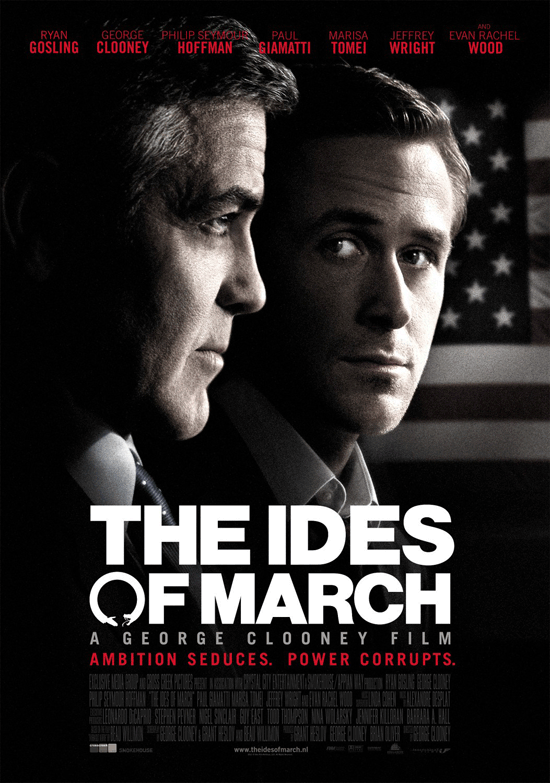
The Ides of March (2011)

“The Ides of March” follows the run-up to the Ohio Democratic primary, with Pennsylvania Governor Mike Morris (George Clooney, also directing) and Arkansas Senator Pullman (Michael Mantell) the last two candidates standing. The race is close, and we learn that the winner will be the prohibitive favorite in the general election.

This is a formidable cast. Philip Seymour Hoffman and Paul Giamatti are the heads of the Morris and Pullman campaigns, Marisa Tomei is a New York Times reporter, Evan Rachel Wood a young intern. But this is not a broad, interlocking-pieces movie, instead focusing narrowly on Stephen Myers (Ryan Gosling), the young media mastermind who is second-in-command of the Morris team. This somewhat defuses the potential for fast-paced scheming but lets us be disarmed as Myers is whenever news arrives and to weigh options alongside him when he has to make decisions.

I’m not sure how to take Myers. Is he a novice idealist or a skilled politico? We don’t get to see much evidence of the superior abilities that everyone – bosses, peers, competitors, flatterers – attribute to him. He is supposed to be smart, capable and experienced beyond his years, but he is easily outmaneuvered by his seniors and shows questionable judgment. To Tomei’s reporter he on the one hand claims idealism to distinguish himself from the well-worn Hoffman, but on the other insists that at the age of 30 he has worked on more campaigns than most others would by 40. It is a puzzle that is never fully resolved, as even Myers’ successes seem more reactive than proactive. Maybe he is more tactician than strategist.

Although it’s nice not to adhere strictly to the standard operating procedure of establishing the hero as an expert before challenging him, these unresolved questions become important because of Myers’ centrality. For a political drama to forgo both clear personal antagonism and complex intrigue is a refreshing risk, but in that case I would perhaps have preferred to know more about Myers.

In Gosling’s other recent starring feature “Drive” his no-name, no-background character is established as a meticulous expert, where here he is merely in charge, so that we somehow know both more and less about him. Here, as there, Gosling is wonderfully patient, with the best moments being when he is processing unexpected news but hasn’t yet reached a decision. Surely Myers – and the audience – can’t be learning for the first time that politics is a dirty business. Gosling’s performance and the unflinching focus on Myers form a good illustration of a point that on reflection should maybe be no less obvious: politics is a lonely business. The film opens with Myers alone on a stage, and ends with him alone in an interview chair, his face filling the screen, and that is really how it has to be all along.

Links: IMDb, Metacritic

Save