
Is it strange that being a sports fan these days has us play-acting at being in charge of the team? Continue reading
Is it strange that being a sports fan these days has us play-acting at being in charge of the team? Continue reading
The excellent essay aggregator The Browser linked this week to an essay by Steve Randy Waldman on the relationship between freedom and risk. It’s an interesting piece and well worth reading. I want to instead talk about the blurb that The Browser wrote to recommend it:
Learned essay on the contradictions between freedom and risk. We almost all want freedom, but few of us want to carry the risks that go with freedom. The history of finance is the history of attempts to lay off or mitigate risk: all of which are doomed to failure. The risk has to accumulate somewhere. And, as in 2008, it eventually blows up.
I know I shouldn’t take this too seriously—it is, after all, just a little hook to encourage readers to click on the link—but I think there are a couple of important things to mention.
I am extensively on record that economics is not the same thing as finance, but of course they are related. Let’s say for the moment that if we can think of economics as being about the allocation of scarce resources, we can think of finance as being about the allocation of scarce capital or money. At the core of economic theory is the idea of mutually beneficial trade: it is possible that we can trade resources and both be better off than before. More than that: a trade willingly entered into by two parties with good information on the things being traded seems almost tautologically mutually beneficial. If it doesn’t benefit both, why do it?
Now of course “good information” is important. For example, when you sell me a used car knowing that it is in fact a few miles away from becoming kaput, I may later be upset. Similarly, in finance, if my information on the riskiness of an asset is bad, I may be sad later, and not just in the sense of being unlucky. But the claim that “all [attempts to lay off or mitigate risk] are doomed to failure” is very peculiar. There are two problems here. The easy one first: clearly not all risks “eventually blow up”. This is the point of risk! If all risks eventually come to pass, then surely they are not risks but racing certainties.
The second problem is that where the risk goes matters. Naturally “the risk has to accumulate somewhere”; we cannot magic away risk by passing it around. But where does it end up? Can the trade of a risky asset be mutually beneficial? Yes: if you are more willing to bear the risk than I am, then you will be willing to part with more to buy that risk than I am willing to accept to sell it. You can buy that risk from me—assume it for your own—and we can both be happier. Think of unemployment insurance: for me to lose my job may be catastrophic. I will be destitute; this risk is very costly for me to bear. For an insurance company, the risk that I lose my job is trivial. The insurance company is happy to absolve me of (some of) this risk, and I am happy to pay them a premium to do so. We are both happy. Dare I even say that my freedom is enhanced when I can trade risk in this way?
So yes, the risk accumulates. But the idea behind all trade is that we might be able to send resources to the place where they are most valuable. And so it is with risk: if we can trade risk, perhaps we can have it accumulate in the hands of those to whom it will be the most bearable. While we do not eliminate the risk, we minimize the pain that is caused if the bad outcomes happen. Hey presto!
Of course there is fraud and lies and bad information, and of course some risks can aggregate into systemic kerfuffles, but let’s not throw the baby out with the bathwater. Trade in risk is not an inherently destructive activity.
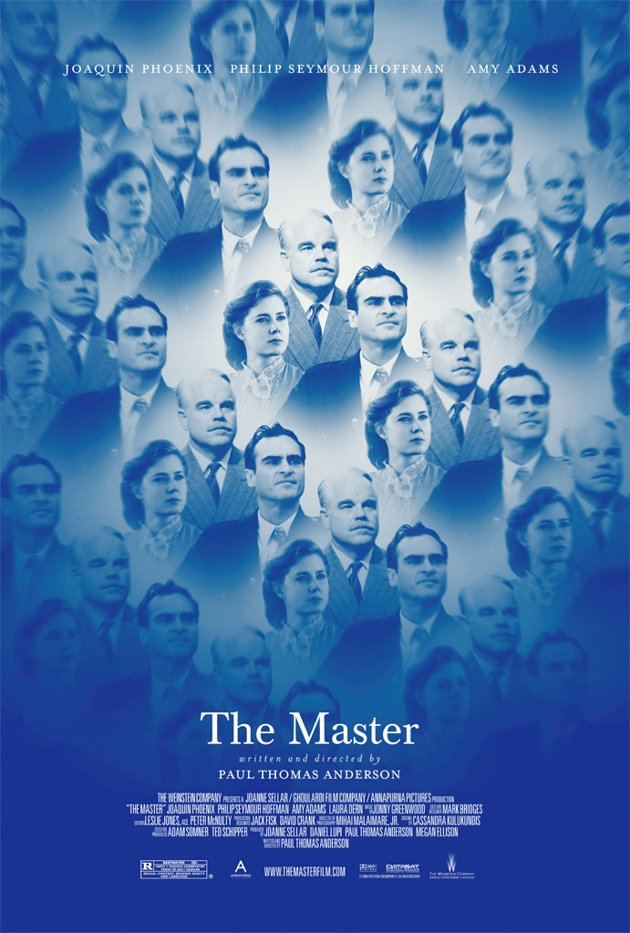
“The Master” begins in much the same way as “There Will Be Blood” (2007), Paul Thomas Anderson’s previous film. We are painstakingly introduced to a man, alone, at length, before any of the other main players get their hands on him. Here the man is Freddie Quell (Joaquin Phoenix), a seaman who we meet at the tail end of the Second World War. There is no fighting. We see him carousing on a beach during downtime and drinking rocket fuel as the end of the war is announced. We follow him back to civilian life, as he drifts from job to job, continuing to concoct drinks from various chemicals and toxins, leaving a trail of alienation and injury. He is screened or treated for what we would now call post-traumatic stress disorder. Whether the war has shaped him in any way is hard to say; he is delivered to us as-is.
Finally, having poisoned a fellow farmhand with the latest of his invented intoxicants, he stows away on a ship full of wealthy revelers. Lancaster Dodd (Philip Seymour Hoffman) is in charge, and finally, having built Quell, Anderson can start to use him. Dodd introduces himself the morning after their offscreen meeting: apparently Quell had been belligerently drunk and offered himself as an able-bodied seaman in need of work; Dodd had discovered a flask of Quell’s homebrew and finished it up. Dodd, we piece together, is the aggrandizing, speechifying inventor of the Cause, a cult-like hodgepodge of self-help and mythos. Quell will become part of his broad entourage as they travel America drumming up support and enjoying the patronage of various adherents. For the rest of the film, then, we will see what Quell can do to this other man, and what can be done to him.
A wonderful key scene establishes the relationship between the two men. On the ship, Dodd offers Quell some “informal processing”, in which he will demand Quell’s concentration and pepper him with insistent questions about his past and his feelings. We learn, among other things, that years earlier a twentysomething Quell had abandoned his sixteen-year-old sweetheart Doris (Madisen Beaty) to go off so sea. Dodd bookends this hypnotic questioning by sharing long draughts of Quell’s brew.
In this way each man is armed. Quell’s booze is cobbled together from whatever he can get his hands on—fuel, darkroom chemicals, paint thinner. It is poison. We know that this poison can be dangerous—the farmhand of the opening—but it doesn’t hurt Quell and it doesn’t hurt Dodd. Instead Dodd relishes it, is fascinated by it. Dodd’s Cause seems much the same. He is accused at various moments of making it all up as he goes along, cobbling together mysticism and pseudoscience into a blend that is not oppressive but exploitative. The hope, optimism and yearning of the various adherents and patrons we meet is attracted to Dodd’s product. Perhaps it harms them as Quell’s drinks would. But Quell is immune to it.
Yet while each has a tool that is frustrated by the other, these two men are not equals. Quell, who seems to exist wholly in the past and the present, uninterested in conceiving of any future at all, can be diverted by the Cause, show an almost feline curiosity in the strange rituals Dodd puts him through, but he cannot be consumed or contained by it. He is a passenger. Dodd, by contrast, orients to the future. What is his next move? What will he have his people do next? What will he write? He snaps at an erstwhile patron at the launch of a new chapter in the lore of the Cause, seeming to feel the pressure of being backed into the corner of his own construction. The allure of Quell and his elixir is to be viscerally present, to be the kind of animalistic spirit that Dodd’s Cause seeks to suppress.
Why, at the heart of it all, do Quell and Dodd stay together? For Quell, maybe it is as simple as him having nowhere pressing to be. He endures plenty of humiliation and punishment with relative ease. Dodd, again possibly inventing on the fly, has Quell walk the length a room for hours on end; he has Quell endure, without reacting, taunts from Dodd’s son-in-law. These seem cathartic for Quell, but never does he change. Dodd disapproves of all of his attempts to “help” the Cause—again and again Quell visits violence on those who dare to be openly skeptical or obstructive to the Cause, and again and again Dodd scolds him, yet keeps him around. He again seems to be exactly the animal that Dodd rails against but seems fascinated by.
Perhaps this is why Peggy (Amy Adams), Dodd’s wife (seemingly the latest in a line) and the film’s maternal presence, is so wary of Quell. His approach to life is not just antagonistic to the Cause, but potentially damaging to her husband, and she seems fully committed to both in a way that Dodd himself is not. She demands that Dodd promise to drink no more of Quell’s hooch, no more of the corrosive stuff. She surely perceives what it is capable of: it renders Dodd under Quell’s power as others are under Dodd’s.
By the end it seems to me that in this meeting of two opposing forces it is Dodd who is broken. Dodd, his daughter and son-in-law, and Quell travel into the desert with a motorcycle. Dodd invents a “game”: pick a point and drive to it as fast as you can. He goes first, speeding off, speeding back. Quell goes next. He doesn’t come back. What point did he pick? He is gone. He goes back to the home of Doris, the girl he left behind years before, but she is gone, married with children now.
Later, Dodd tracks Quell down (or Quell dreams that he does) and asks him to come to England, where he has established a school. Quell had ridden free, yet he goes. Why? On his arrival, he is berated by Peggy and scolded by Dodd: how dare he have abandoned them? If he stays, he must commit to the Cause. If he leaves again, Dodd warns, he cannot come back. But Quell cannot be tamed this way. Dodd is powerless. Whether or not it was because of his relationship with Dodd, Quell has finally addressed something other than the present.
“There Will Be Blood”, Paul Thomas Anderson’s previous film, in retrospect had a relatively straightforward title. Here there are plenty of candidates for the title of Master. Quell or Dodd? The booze or the Cause? Who is in charge of whom?
Links: IMDb, Metacritic
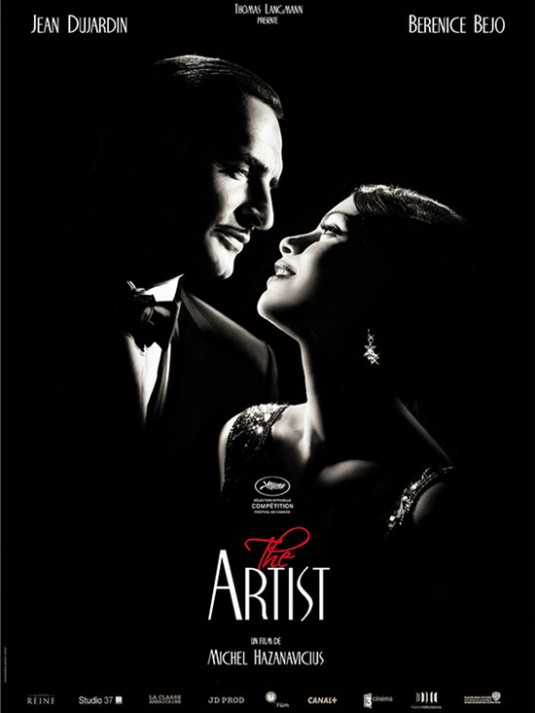
“The Artist” of the title is, I presume, George Valentin (Jean Dujardin), a silent film actor in the late 1920s, about to be rendered obsolete by the talkies. He isn’t much of an artist. Dujardin’s brilliant mugging as he acts the actor acting (if you see what I mean), his identikit pictures, his glamorous swagger: this is a star, and Hollywood is an industry. Michel Hazanavicius’s silent, black-and-white homage to the era uses great craft to pastiche an era when the craft was a little less sophisticated.
Before sound arrives and the silent industry collapses, Valentin, at a premiere of his latest movie, literally bumps into Peppy Miller (Bérénice Bejo), who is in the mass of fans outside the theater. Their chance meeting is splashed over the gossip pages. That, of course, will not be that. She is hired as a dancer for Valentin’s latest feature; when she is recognized as the troublemaker from the newspapers, she is saved from being fired only by Valentin’s intervention.
This first act was my favorite by quite a margin. Later there is classic melodrama, but first we have classic comedy. The stylized black-and-white, silent nostalgia worked a lot better for me in service of the light romp of the preening star than the descent to come later. And it does work. Dujardin and Bejo look just right, and survive perfectly well without words. For some reason I think Valentin and Miller’s cute-as-a-button spark as they catch the giggles while trying to film a scene would have been much less sympathetic with sound.
Valentin is about to pass Miller on the way down, as the talkies will launch her to the top just as they cast Valentin aside. Their moment together is past unrequited, with Valentin returning to his distressingly complete alienation of affection for his wife, and Miller whisked off to stardom. It’s lucky that the brief scenes of their meeting work so well, since they have to carry the weight of the two stars’ opposing fortunes as well as the affection the two clearly feel for each other.
What kind of affection is not clear. Maybe by the Hays-code constraints of the movie’s style, chastity is unbreakable? In this way the constraints bleed into the action, and I found myself wondering if there was anything we weren’t seeing. Valentin descends – at length – into booze and despair, and Miller works occasionally to help him, silently so as not to hurt his pride, but the precise why stays unknown. I thought as the pace settled down while Valentin falls, the stylistic facade seemed a little less convincing. An homage to comedy still gets to tell jokes after all.
It seems to be that pride that does Valentin in, but again I wasn’t sure exactly why. At the moment his fortune turns, Valentin’s producer Al Zimmer (John Goodman) shows him a screen test of an actress with sound. Valentin leaves, laughing. Is he being forced out of the industry, obsolete, as Zimmer claims later? Or is he walking through the door alone, refusing to ride this new wave, unable or afraid? At times it seems to be him, and at others the world. I suppose things always seems a little that way when things are going badly.
In any case the movie certainly doesn’t seem to take a stand one way or the other. Which is fine; “The Artist” is a sweet confection, not an exercise in whys. To revel in the sights, sounds and mechanics of a bygone era seems to be the goal, and the material itself is very much a square peg for the square hole of the style. I wonder whether the same nostalgic style could ever work with something a bit more complicated, or if the medium really constrains the possibilities of the story. Does silence restrict a movie to simple emotions, or does everything just look simpler in silence?
Links: IMDb, Metacritic
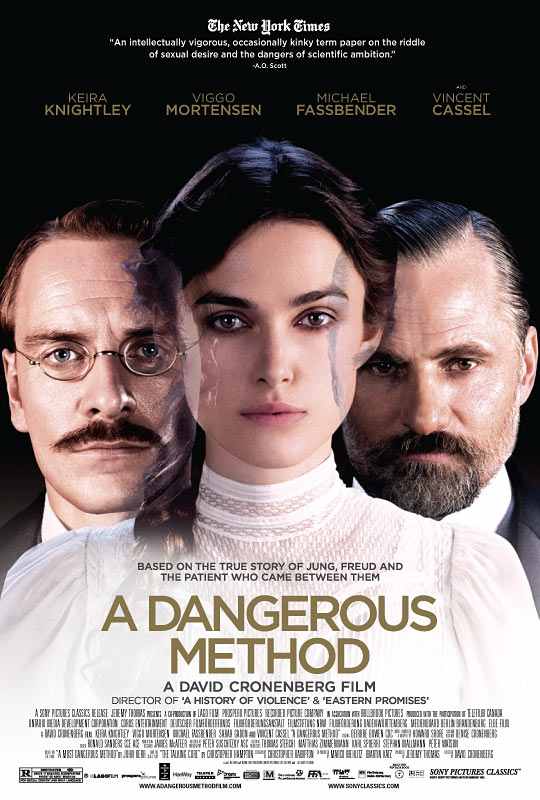
The three people at the center of David Cronenberg’s “A Dangerous Method” aren’t a love triangle in the traditional sense, but their relationship is just as messy. The movie follows the fathers of psychoanalysis, Sigmund Freud (Viggo Mortensen) and Carl Jung (Michael Fassbender), and Sabina Spielrein (Kiera Knightley), patient and later lover of Jung, still later patient of Freud, still later student of both and a renowned psychiatrist in her own right. It’s a complicated path.
The movie opens with a screaming and resistant Spielrein, daughter to a wealthy Russian businessman, being committed to a psychiatric hospital. There she meets Jung, who explains that he will try the new “talking cure”. He sits behind her, so as not to distract her, he says: Knightley then is facing us directly, her face filling the screen, with Fassbender behind. As he questions her, her face contorts and her voice whispers and shrieks – the performance is almost over-the-top and certainly uncomfortable to watch, which I suppose is the whole point.
We cut to Jung and Spielrein strolling the hospital grounds, talking on much the same basis as in the treatment room. But wasn’t Jung supposed to be out of sight during the treatment? What could be going on here? It immediately seems inevitable that Jung and Spielrein are certainly not going to be just doctor and patient. Surely Jung can see this too; for him to insist on being in the background at one moment and to talk on equal footing the next seems to ask for trouble. Either there will be heroic compartmentalization or things will get complicated.
Eventually the two will indeed become lovers, even as Jung’s wife produces a series of children. Their affair will see Spielrein satisfying the fetishes that were exposed by her talk therapy and that she had believed were wrong and made her dangerous and broken. Jung seems tawdry by comparison. Despite some hand-wringing about whether it is right to explore or repress base urges, ultimately his motivation seems to be the obvious one. Either way it was a little surprising to hear the two of them talk later in the movie about their outsized love for each other; at times there didn’t seem to be a lot between them.
Against all this, Jung and Freud are meeting for the first time and developing a personal and professional relationship. Freud praises the younger man as the heir to the throne; Jung calls Freud a father figure. But Freud, with Mortensen showing him judicious and logical, believes in strict and narrow psychoanalysis, concerned with the perception of their new field from outside. He seems to be a marketer and frames his favoring of Jung as a way to give the profession a face not of the Vienna Jewish community. Jung interprets these not as political acts but as evidence that Freud is no longer an innovator. He wants instead to promote a broader psychoanalysis, one that includes things that Freud sees as unscientific at best and superstitious at worst. Their polite parrying darkens as time goes on; my favorite scenes of the movie were those with Mortensen and Fassbender alone, the gentle tension between them ebbing and flowing.
But in the end for all the talk in the film, the difference of opinion between Freud and Jung is not really explained in great depth. Their relationship really breaks down in the regular fashion, no matter how much they try to cover the rift with the fig-leaf of intellectual disagreement. Jung’s relationship with Spielrein colors their arguments and, when Spielrein forces Jung to reveal it to Freud, disappoints the older man. Fassbender, in Jung and in his other recent starring role, seems to have nailed down playing ashamed, although here it not because of the sex itself but the deceit. Jung seems to be unable to address his desires. As he fights Freud’s belief that the root of all patients’ problems is sexual, the affair with Spielrein frays his nerves.
To complete the triangle, after their affair is exploded, Spielrein demands that Jung recommend that Freud take her as a patient. She seems unleashed by Freud’s method and her affair with Jung from what had been debilitating illness, and is now training to be a psychiatrist in her own right. With Freud as a pivot, the doctor and patient are in the process of switching roles, he ruined and on the verge of a nervous breakdown after losing his young mistress and his mentor, and she developing Freud’s work in new directions, impressing the old man in the role he had earmarked for Jung. In the end it is Spielrein who is the strong and confident center, against the aging Freud and the crumbling Jung.
Links: IMDb, Metacritic
One sentence stuck out to me from an otherwise poignant article on healthcare and assistance for the very elderly:
Politicians are champing at the bit to cut back on Social Security and Medicare at a time when so many of us will depend on them.
I know this is just a throwaway shorthand and I shouldn’t get so worked up about it. But I find it incredibly difficult to believe that any self-interested politician wouldn’t lavish cash on the elderly (a.k.a. reliable voters) if it was feasible to do so. Even if I’m wrong about that, this is an example of an omission that sometimes bothers me: in some broad sense, resources have to come from somewhere. Slightly earlier in the article is this:
American political leaders are not preparing adequately for the huge demographic shift caused by the aging of the boomers, who began turning sixty-five in 2011.
So surely the earlier quotation should really say that all else equal politicians will have to find a way to cut back on Social Security and Medicare? What would the preparation be? The proportion of the population that is working-age is going to fall. That means fewer people working to turn stuff into other useful stuff, and more people not working but hoping for a share of the stuff. Something must give. Either more stuff has to be foregone by the workers, or less stuff enjoyed by the non-workers.
Government, whatever it is, isn’t a grumpy gatekeeper protecting a bottomless barrel of stuff and saying “no, no, no”. We can disagree about what government should do, of course, but let’s not pretend that there aren’t constraints.
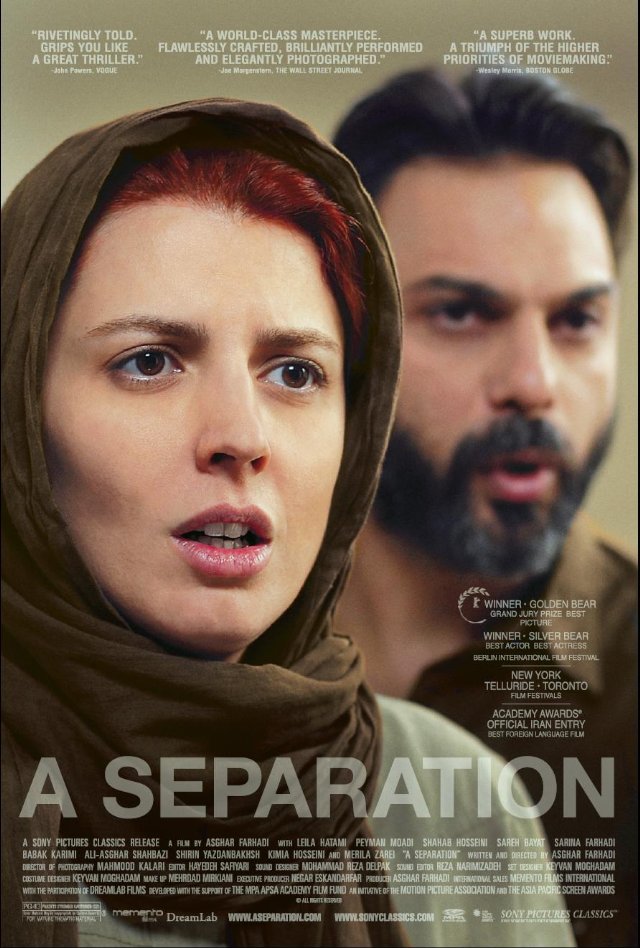 Asghar Farhadi’s “A Separation” begins with husband and wife Nader (Peyman Moadi) and Simin (Leila Hatami) sitting side by side, facing us, explaining their problem to an unseen adjudicator. They had planned to emigrate, for a better life for their daughter, she says. They finally have visas to leave, and 40 days left to use them. But Nader’s father has Alzheimer’s: how can he leave his father, he asks? His father no longer recognizes him, Simi says. But he recognizes his father, Nader says. And so on. Simin has petitioned for divorce, threatening to leave without him.
It is too reasonable and too difficult. The camera sits unmoving, pinning us in the adjudicator’s chair as Simin pleads and Nader rebuts, but how could we possibly decide? There can be no victory for anyone. Both positions are reasonable. Thus the separation happens. Simin leaves the family home, laboring her exit but in vain: Nader does not try to stop her. In Simin’s absence, Nader hires Razieh (Sareh Bayat) to care for his father during the day. This sets off a situation that mirrors the reasonableness and difficulty of the original dilemma, but this one more complex and urgent. Again we are put in the impossible position of trying to adjudicate.
Razieh, pregnant and with her daughter in tow, comes to work. The commute is long and the job is difficult, and, worse, Razieh is concealing from her unemployed husband Hodjat (Shahab Hosseini) that she is working at all. She is conscientious but suffering, having spells of dizziness and fatigue. Nader he comes home early one day to find Razieh and her daughter gone, the door locked, and his father tied to the bed and unconscious. Money is missing too; we know that there is an innocent explanation for this but Nader does not. He is angry. When Razieh returns, he orders her out of the house, but she comes back to protest her innocence of the theft. When Nader throws her out a second time, he seems to push her out the door. Neighbors find her injured in the stairway. Later, in hospital, we lean that she has miscarried.
Nader is accused of manslaughter. Did he know that Razieh was pregnant? If so, the judge decides, he can reasonably be punished for killing the child. The decision will hinge on this piece of information, but while the court goes about trying to learn it, we are tormented by watching all of the players laid out on the rack of a brutal situation that is immensely more complicated than any legal decision could ever allow.
“A Separation” isn’t a many-perspectives movie, but it pulls off with astonishing success the trick that that genre most covets, the harnessing of sympathy for each character very nearly always, even when they are in direct opposition. The predicament is finely poised, the actions of all the players terribly understandable, and a successful resolution for everyone utterly impossible. I found it almost overwhelming. Where a movie like “Crash” (2004) attempts the same by having heroes and villains exchange places from moment to moment, “A Separation” needs no heroes or villains. The shifts, such as they are, are in emotional perspective and they’re impeccably subtle. I can’t think of another movie that performs this magic so well.
The tiny crack in the armor is Nader’s passivity. Throughout he asks others to judge and decide for him. Simin can leave if she wants, he says. If his daughter Termeh thinks him guilty she should do one thing, and if not another. This equivocating could endanger the plot’s perfect conceit by making it seem merely unsolved rather than insoluble: it almost seemed as if things could be OK if only Nader could decide something for himself. But Nader, being at the center of things, is in the end the most like us, skewered on a Morton’s fork of impossible choices. It’s hard to blame Nader for his passivity when it is so difficult for us as mere observers to decide what is right.
And always there is Nader’s father. It is hard to say whether he is only an excuse for Nader to avoid emigrating with his family, despite his obvious devotion, but in this desperate movie he is indispensable, the one immovable object in the fluid tragedy. Without him the conflicts would be petty; he is an anchor to the tragedy, the more so that his disease has him a shadow of whatever he once was. After the separation he whispers Simin’s name, questioning as best he can, to Nader. After the day of Razieh’s tragedy he falls silent entirely. Simin is not there anymore.
She is often absent for us, too, as Farhadi keeps her offscreen for long chunks in which the worst of the tragedy is happening. We don’t see what she is up to in the meantime. Neither does she see the nuance of the situation when returns, because she is the active force, seeking solutions. Watching her actions when she is pulled back in, it is difficult to imagine that the decision to emigrate was not hers alone.
In the separation there has been nothing but catastrophe. Simin and Nader’s original dilemma, then, has been horribly amplified: if only they had been together, these things would never had happened. Should Simin never have left, forgoing her dream of a better life for them all? Should Nader have agreed to go, leaving his father and the world he knows? We arrive back where we started. In a perfect final scene it is Termeh who is being hounded to decide between her parents. Repeatedly she is asked: have you decided? How can she make such a decision?
Links:
IMDb, Metacritic
Here is a nice review by Burton Malkiel of “Models Behaving Badly” by Emanuel Derman. The models of the title are from the world of finance: how are assets priced?
I am a layperson to the world of finance, so I find it difficult how to apportion “blame” for financial crises on faulty models or fraudulent inputs to them. Certainly history is littered with financial crises, so the influence of modern modeling alone cannot explain everything.
In any case, I just want to take this opportunity for a small lament that the beautiful act of modeling must be dragged through the mud by a financial crisis in this way. It would be fair to say that I am almost fanatical about the virtues of the concept and practice of modeling. I believe that modeling is inescapable. The world is complicated. Our senses deliver so much information, our mental apparatus must work so hard, that to process the world around us is to model. It is too much to ask that we understand everything; we have to understand a version of everything that is not so complex as the world.
This is also why economics works with models. We don’t have a scale replica of the world that we can play with to see how this affects that. We have to build a scale replica from scratch, using our best judgment to push insistently at the boundary between complexity (so that we can understand our model) and usefulness (so that we can make something from it).
In a way we are much luckier in economics than in finance. Progress in economic theory comes as our models are improved upon and refined, but we are more able to iterate forward because our models are not embedded in a Leviathan global finance industry that depends on their continued function. Creative destruction of old models is hard when the house comes down with them.
With all this in mind I want to highlight this passage from the review:
He sums up his key points about how to keep models from going bad by quoting excerpts from his “Financial Modeler’s Manifesto” (written with Paul Wilmott), a paper he published a couple of years ago. Among its admonitions: “I will always look over my shoulder and never forget that the model is not the world”; “I will not be overly impressed with mathematics”; “I will never sacrifice reality for elegance”; “I will not give the people who use my models false comfort about their accuracy”; “I understand that my work may have enormous effects on society and the economy, many beyond my apprehension.”
How many of these will I accept for economics? Certainly the first; the model is not reality. Certainly the second; math is helpful in model-building but is not the point of model-building. The fourth and fifth are hard to argue with.
The third I don’t like. Everything that we do must sacrifice reality. The test of a model is not its realism (a realistic model airplane would be no fun at all). All models are unrealistic because all models are wrong. Of course elegance is not the test of a model either, except that an elegant model is one that illuminates a relationship in a clear way by cutting to the heart of what matters.
Anyway, the point is that I think that “model” is not a dirty word. I feel possessive about “modeling” much the same way as I feel possessive about “rationality” – what they mean to me is important and wonderful and I hate to see them sullied by misrepresentation that stems from their overlap with the real-world ideas of modeling and rationality. I wish that all of the things like these could have their own words that are not borrowed from natural language.
 Jim Campbell